The Tagin language, spoken by the Tagin tribe—one of the major tribes of Arunachal Pradesh in Northeast India—is predominantly used in the Upper Subansiri district of Arunachal Pradesh. It belongs to the Tani subgroup of the Sino-Tibetan language family. Tagin is not merely a medium of daily communication but also a living repository of history, a ceremonial standard, and the foundational social and spiritual code that underpins customary practices. As early as 1953, just before the advent of modern administration and political systems in the region, the Tagin people and their language were largely unknown to the outside world, except to Tibet, with whom they maintained trade and commercial relations. Thus, the spoken language alone existed and prevailed, and the Tagin writing system was unknown until then.
The formal arrival of the modern administrative and political system in the Tagin region occurred for the first time only in late 1953. The Indian government became aware of the existence of the Tagin community following the Achingmori Massacre in October 1953. Subsequently, after the successful mission led by Major S. M. Krisnatry, Assistant Political Officer, and his wife Geeta Krisnatry in 1956—just three years after the massacre—administrative centres were established, and good relationships were forged with the Tagin people.
With the establishment of administrative headquarters at Daporijo, Taliha, and Dumporijo/Gusar in 1953, followed by Nacho and Limeking in 1956, the arrival of government functionaries from mainland India ushered in a new cultural phase. Along with it came a new language environment and the introduction of a writing system, which had hitherto been unknown to the Tagin.
Gradually, the people became more aware of the modern administrative system, its functions, and the benefits it offered. As a result, they grew more confident in themselves and developed trust in the new administrative and political framework. Learning modern languages—such as Assamese and Hindi—became a basic necessity, while some, especially those attending school or working in offices, also learned English. The abrupt introduction of a writing system marked one of the most defining moments in the Tagin community’s economic growth and social progress.
With the advent of modern administration and political systems, a writing system known as Paadam Siti (Paadam writing), based on the Roman script, emerged within the socio-cultural milieu of Tagin society. However, this system proved inadequate in addressing the tonal and phonetic requirements essential for accurately representing the tones and pronunciations of Tagin. Notably, it lacked representation for the sounds V (equivalent to अ in Devanagari and ɘ in IPA) and W (ɯ in IPA). These sounds, which are prevalent in many Asian languages, constitute a fundamental component of Tagin phonetics and linguistic structure. The absence of these sounds in the Paadam Siti system resulted in a misalignment between the spoken language and its written form, leading to misinterpretations and discrepancies in pronunciation.
In the annals of the Tagin linguistic preservation journey, the year 2012, marked by the Third TCS General Conference held from 15th to 17th December, will always remain a red-letter day. During this conference, an epoch-making decision was made to develop a new writing script for the Tagin language, as the existing system failed to provide accurate tonal representation and could not precisely produce the desired sounds. The motion was proposed by the late Er. Tabu Paktung and received unanimous support from the house. Subsequently, he was elected unopposed as the third President of the Tagin Cultural Society (TCS)—the apex social body of the Tagin community—alongside Er. Lardik Kare, who was also elected unopposed as the Secretary General of the society.
After formally assuming the reins of the TCS, the very first step taken was to constitute a dedicated body tasked with steering the initiative to develop a script for writing the Tagin language. From the outset, the society found itself grappling with where and how to begin, as the domain of script development was a highly specialized field—entirely new not only to the TCS but also to its individuals.
In truth, the initial phase involved groping in the dark, trying to find a way forward. Extensive internet searches for linguistic experts and organizations yielded no responses, and letters written to known organizations went unanswered.
In pursuance of the resolution adopted during the august assembly of the Tagin Cultural Society (TCS) at its 3rd General Conference, an interim committee was constituted on 21st January, 2013 for a period of three months to explore viable ways for the development of the Tagin language. As this committee did not submit its report within the stipulated timeframe, a new committee, under the nomenclature of the Tagin Language Development Committee (TLDC), was formally constituted on 10th August, 2013 with Er. Lardik Kare, Secretary General, TCS, as the Chairman, and Mr. Baman Gyama as Member Secretary.
Operating entirely under the aegis of the Tagin Cultural Society (TCS), a series of meetings were convened to identify individuals and organizations capable of supporting the TCS and TLDC in the development of the Tagin language.
In one such meeting, Mr. Baman Gyama informed the members about an organization known as the North East Centre for Training and Research (NECTAR) based in Shillong, Meghalaya. The TLDC resolved to initiate formal contact. On 26th October 2013, at Arunachal Bhavan, Shillong, Er. Lardik Kare held a bilateral meeting with Mr. Nengzakhup Suante, Director of NECTAR. The principal outcome was NECTAR’s commitment to extend training support and provide specialized technical guidance to TCS, channelled through the TLDC, for the systematic development of the Tagin language script.
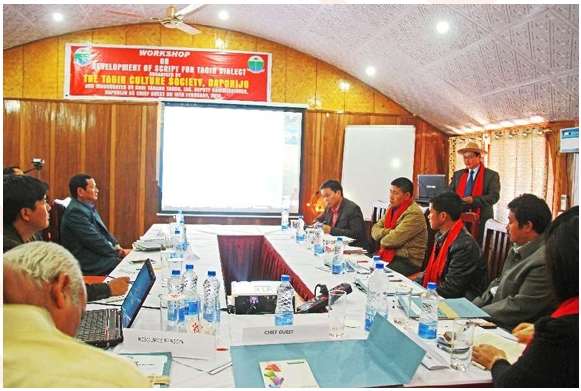
After unwavering and sustained efforts, the long-anticipated fruits of dedication culminated in a landmark achievement: the Workshop on Development of Tagin Dialect, held on 19th February, 2014. In accordance with the resolution, NECTAR deputed its technical expert, Miss Jenie B. A. Sangma, Literacy Coordinator, to supervise and facilitate the workshop. Her contribution was instrumental in guiding the technical proceedings and enabling a structured exploration of phonetic, orthographic, and tonal dimensions.
The workshop witnessed enthusiastic and meaningful participation from a wide spectrum of intellectuals and community stakeholders. At its conclusion, a significant breakthrough was achieved: the birth of the Tagin Language Script in the form of a Modified Roman Script. This newly adopted script was carefully adapted to accommodate the tonal nuances, phonemic distinctions, and pronunciation patterns inherent to the Tagin language—thereby addressing limitations of the earlier orthographic model. Simultaneously, this day marked the formal discontinuation of the previously used Tagin script. In the annals of Tagin cultural renaissance, 19th February, 2014 shall be remembered as a red-letter day.
The contribution of NECTAR to the Tagin community in the domain of language and script development shall remain etched in collective memory. Their timely intervention, both technical and moral, was not merely supportive—it was catalytic, providing the tools and confidence to embark on the complex process of linguistic development.
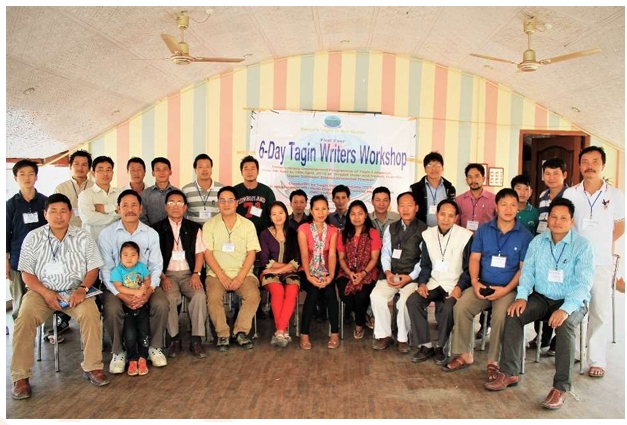
Continuing the momentum, a second major initiative was undertaken in the form of the 6-Day Tagin Writers’ Workshop, held from 8th to 14th April, 2015 at Daporijo. Bringing together twenty-eight participants, the primary focus was to provide structured training in the comprehension and practical application of the newly developed Tagin script. Participants were guided on how to effectively utilize the script in written expression, with particular emphasis on tonal accuracy and phonological suitability.
In addition to script familiarization, the workshop introduced foundational techniques in creative writing. On the concluding day of the workshop, 14th April, 2015, a resolution was formally adopted to publish children’s primers and Tagin folk tales in the Tagin language, advancing the community’s commitment to linguistic preservation and revitalization.
Over time, it became increasingly evident that the mandate of the Tagin Language Development Committee (TLDC) extended beyond mere language development. The scope of work involved substantial and in-depth research into the linguistic structure, phonology, and cultural dimensions of the Tagin language. In recognition of this expanded role, the nomenclature of TLDC was formally revised to include the term Research, resulting in the new designation: Tagin Language Research and Development Committee (TLRDC).
As TLRDC progressed in its mission, it encountered several operational scenarios that underscored the necessity for institutional autonomy. The need to function independently—without complete reliance on the Tagin Cultural Society (TCS)—became critical for the effective execution of its growing responsibilities and specialized tasks. In response to these structural limitations and in pursuit of greater organizational independence, the entity underwent a final transformation in nomenclature, emerging as the Tagin Language Research and Development Society (TLRDS).
This transition marked a pivotal step toward institutional maturity and self-governance. Subsequently, TLRDS was formally registered under the Society Registration Act of Arunachal Pradesh on 10th March, 2025.